
Selection of cooling tower (CT) depends upon the application and surrounding conditions. It is the cost effective heat removal solution used for removing large heat load.
How Cooling Tower Works
It cools water based on diffusion principle.
When water particles comes in contact with moving air, some amount of the water evaporates and while evaporating it takes latent heat from rest of the water of the particle.
This process reduces temperature of the whole particle much lower than air temperature (more accurately air dry bulb temperature).
This is the reason why a CT can produce more cooling effect than radiator. Wet bulb temperature plays important role in cooling tower design and selection.
Types of Cooling Towers
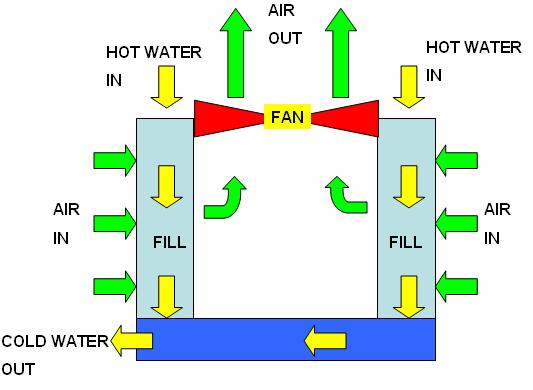
- Cross Flow: Here, flow of air and flow of water crosses each other while exchanging heat. Below picture is self explanatory of how this types of cooling tower works.
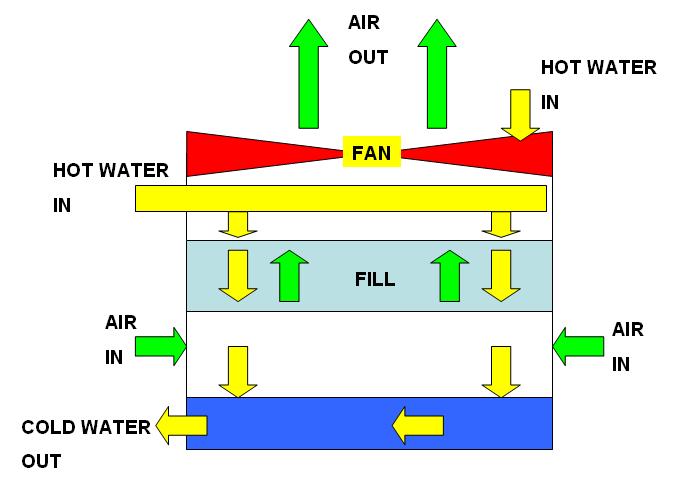
- Counter flow: Here heat exchange between water and air occurs while they pass each other in opposite direction. Below figure explains working of a typical counter flow type of CT:
- Natural draft : Natural draft CT doesn’t use a fan to suck air from surroundings, it works on natural flow of air. Because of height difference (i.e. pressure difference) air naturally flow from bottom to top, which creates natural flow of air. These types of CT are generally used in nuclear power plant.
- Force draft : Here fans are used to create positive pressure difference and to generate air flow.

brother i want to know the complete types of cooling tower with detail CAN U HELP ME
Very detailed and specific information. Thanks for sharing this man! 😀
Cooling Towers in Australia